
Trailing Drawdown Explained: EOD vs Intraday (and Why It Blows Up Accounts)
Trailing drawdown explained with real numbers: how the loss limit ratchets up, why intraday vs EOD matters, which firms use which, and how to trade around it.

A trailing drawdown is a loss limit that moves up with your account’s high‑water mark but never moves back down, so unrealized gains you give back can fail your account even while you’re still in profit. The two flavors, end‑of‑day (EOD) and intraday, behave very differently, and which one your firm uses decides whether a normal pullback is a non‑event or a funeral.
More funded accounts die to this single rule than to bad trades. Not because traders can’t read price, because they never understood the floor moving underneath them. Here’s the whole mechanic, with numbers.
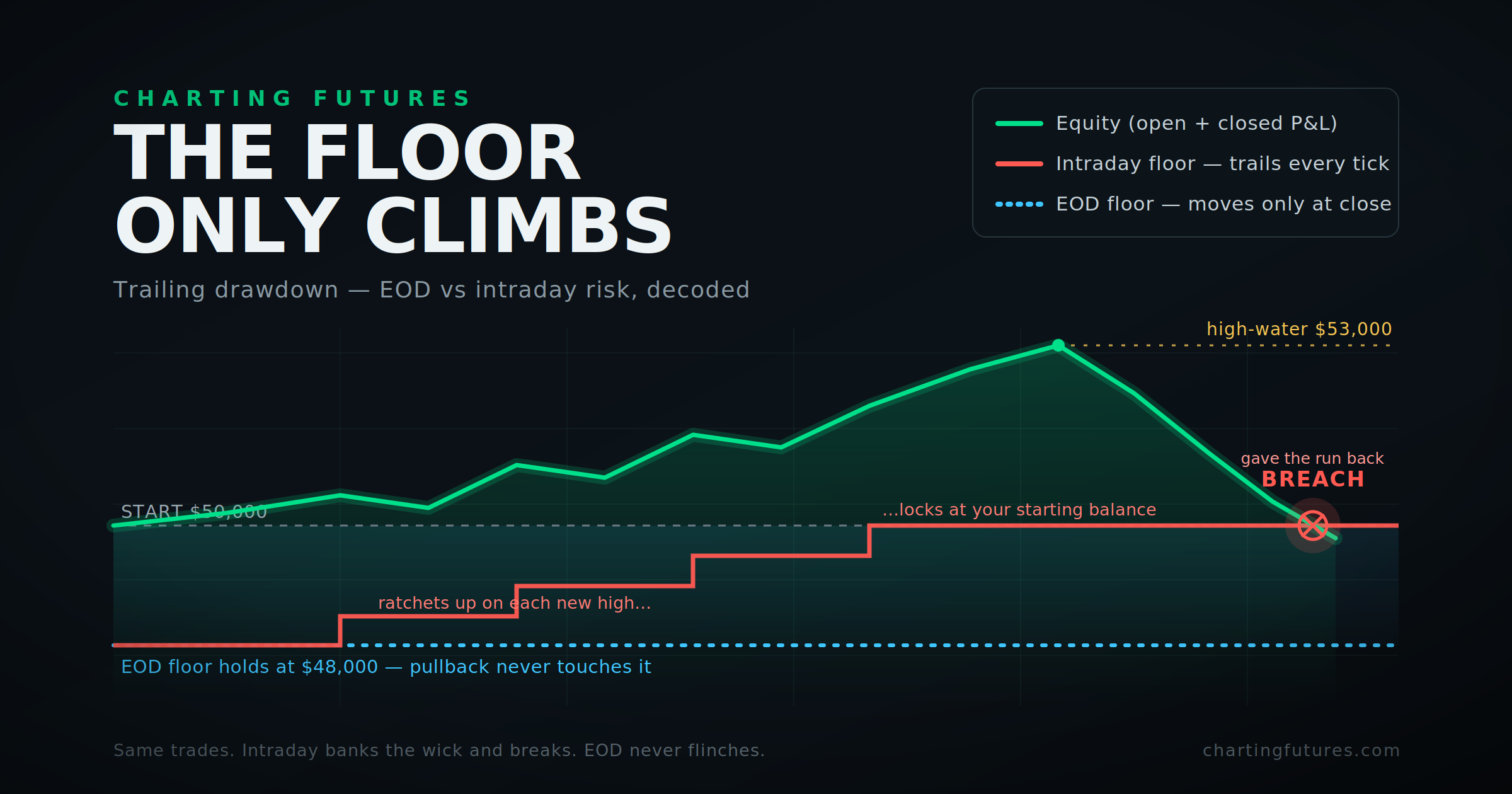
What a trailing drawdown actually is
Every funded account ships with a maximum loss limit, a hard floor. Touch it and the account is done. With a static drawdown that floor never moves: simple, rare, usually paired with tougher targets.
A trailing drawdown is different. The floor is tied to your high‑water mark, the best your account has been, and it follows that mark upward only. Make new highs and the floor rises behind you. Give those highs back and the floor stays exactly where it climbed to. It is a one‑way ratchet.
That ratchet has one piece of good news baked in: the lock. On almost every major firm, once the floor climbs all the way to your starting balance, it stops trailing and freezes there. From that point you have a fixed floor at your start, and every dollar above it is free cushion. The entire game of a trailing‑drawdown account is surviving the dangerous stretch before the lock.
EOD vs intraday: the only distinction that matters
There are two ways a firm decides when the floor is allowed to move. This is the whole ballgame.
Intraday trailing moves the floor in real time, tick by tick, on unrealized profit. The instant your open position floats to a new equity high, the floor jumps up to match, whether or not you ever close that trade. A green wick you never bank still permanently tightens your room.
End‑of‑day (EOD) trailing only recalculates the floor once per day, at session close, off your closing balance. Intraday spikes, wicks, and floating profit do nothing until they become part of a settled close. You can be up $1,500, give it all back, and the floor doesn’t budge until the bell.
Same name. Opposite risk profile.
The worked example: where accounts actually die
Take a $50,000 account with a $2,000 trailing drawdown. Floor starts at $48,000. Now run one identical session through both models.
You go long. The trade floats to +$1,500 (equity $51,500). You give most of it back and you’re sitting at +$300 (equity $50,300), still green on the day. Then a completely routine pullback knocks off another $900 (equity $49,400).
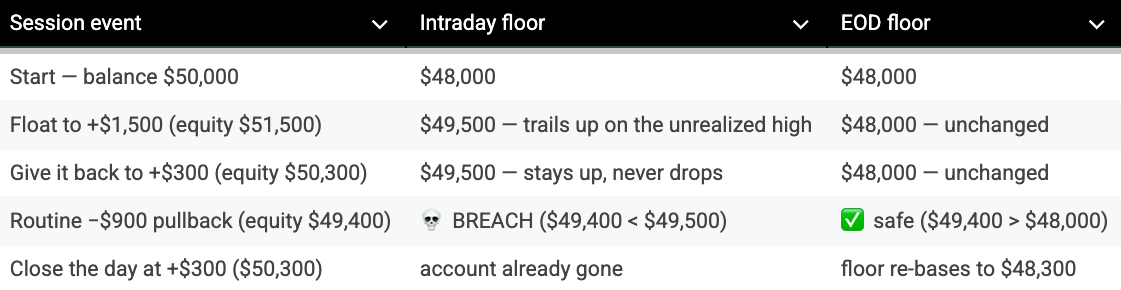
Read what happened on the intraday side. You never booked a loss. You were up most of the session. But the floor quietly banked a peak you never realized, your usable buffer collapsed from $2,000 to $800 without a single closed trade, and an ordinary wiggle ended the account. That is “blows up while still in profit” in one sequence.
On the EOD side, the spike to $51,500 and the give‑back were noise. The floor sat at $48,000 the entire session, the $900 pullback was nowhere near it, and you closed green and banked $300.
The lock, in the same example: keep stacking higher closing days and the EOD floor eventually climbs to your starting balance. Close a day at $52,000+ and the floor reaches $50,000, locks, and never trails again, fixed floor at your start, free run above it.
Which firms use which
This is the part traders skip and then pay for. The model is a property of the firm — and sometimes the plan and phase — not the industry.
Alpha Futures: EOD across all plans. The floor only re‑bases on your highest end‑of‑day balance and locks at your starting balance once you’ve banked the buffer. One of the most forgiving structures for anyone whose edge needs to hold through intraday noise. (More on the firm itself: Is Alpha Futures Legit?)
Topstep: EOD trailing (their “Maximum Loss Limit”), locks at the starting balance. Trades get room to breathe during the session.
Apex Trader Funding: since the March 2026 overhaul you choose EOD or intraday at checkout. The intraday option is cheaper and carries no daily loss limit; the EOD option costs more and adds one. Pick deliberately — you’re picking your risk model, not just a price.
Take Profit Trader: phase‑dependent: EOD on the evaluation, intraday once you’re in the PRO funded stage, then EOD again on PRO+. The “forgiving” reputation only applies to the test.
My Funded Futures: EOD on Core/Pro tiers, intraday on the Rapid plan.
Static‑drawdown outliers: a handful of (mostly forex‑rooted) firms never trail at all. Rare in futures, and usually traded for harder targets.
Rules in this space change often, Apex rewrote its entire model overnight. Always confirm the current terms in the firm’s own help center before you buy.
How to trade around it
If you’re on an intraday floor, treat unrealized profit as a liability, not a trophy. Don’t chase the high‑water mark, every tick up you don’t bank tightens your liquidation point. Manage with stops inside your remaining room, not your theoretical hard stop. Book partials so the floor follows realized gains you actually keep, and size for the worst wick of the trade, not the close. Your real enemy is the round‑trip.
If you’re on an EOD floor, you bought the right to hold through intraday adversity, use it, but don’t abuse it. Close green to ratchet the floor up and march toward the lock. Respect any daily‑loss guard layered on top. And watch the trap that kills funded EOD accounts: after a payout, your buffer often shrinks with the withdrawal, so the math gets razor‑thin exactly when you feel safest.
Bottom line
A trailing drawdown isn’t a gimmick, it’s the rule that quietly decides whether you keep the account. Intraday punishes you for unrealized profit you give back. EOD judges you only at the close and lets the session breathe. Match the model to how your edge actually behaves before you put money down, and respect the floor more than the target.