
Is Alpha Futures Legit? Rules, Drawdown & Payouts (2026)
An honest 2026 breakdown of Alpha Futures - the EOD trailing drawdown, the 90% split, the three plans, and who the prop firm actually suits.

Short answer: yes, Alpha Futures is a real, UK-registered futures prop firm (Alpha Futures Limited, part of the Alpha Capital Group) that runs a one-step evaluation, pays a flat 90% profit split on every plan, and uses an end-of-day trailing drawdown that stops trailing once it reaches your starting balance. That last mechanic is the whole reason traders single it out, and it’s where most of this review lives. If you take heat intraday but tend to close near your highs, it’s one of the more forgiving structures in the funded-futures space. If you’re a one-big-day lottery trader, the rules are built specifically to stop you.
Here’s the honest breakdown, the drawdown, the three plans, the payouts, and the catch.

What is Alpha Futures?
Alpha Futures is a futures-only prop firm. You pay a monthly subscription, pass a one-step evaluation by hitting a profit target without breaching the loss limit, and you’re promoted to a “Qualified” simulated-funded account where you keep 90% of the profits. There’s no multi-phase challenge and no time limit on the evaluation - hit the target, respect the rules, get qualified.
It gives access to CME Group products across the CME, CBOT, NYMEX and COMEX exchanges, and runs on a broad platform list with their own AlphaTrader (built with the Plus500 team), plus Tradovate, NinjaTrader, WealthCharts, Quantower and Deepcharts. Tradovate is the usual route if you want to automate. For a sense of scale, Alpha markets a 4.9/5 Trustpilot rating, $70M in performance fees paid, and 175,000+ Qualified Analysts across 140+ countries, with allocation up to $750K in simulated funds — this is an established operation, not a fly-by-night. The current lineup is three plans — Zero, Advanced and Premium — which I’ll compare below.
The EOD trailing drawdown - the part that actually matters
This is the headline, so let’s be precise about it, because it’s where Alpha genuinely differs from a lot of competitors.
Every Alpha account uses a Maximum Loss Limit (MLL) that trails end-of-day, not intraday. Plenty of firms trail your drawdown off your intraday equity peak, meaning one spike up followed by a pullback can blow your account even if you close the day green. Alpha only recalculates the MLL off your end-of-day balance high. During the session, your floor doesn’t move.
Better still, the MLL stops trailing once it reaches your starting balance. Here’s their own worked example on a $50k account:
You start with a $50k account; your MLL begins at $48,000 (-$2,000).
Make $500 on day one (balance $50,500) MLL trails up to $48,500.
Lose that $500 the next day (balance back to $50,000), but the MLL stays at $48,500. It never moves down.
Once your end-of-day balance hits +4% ($52,000), the MLL locks at $50,000 (your starting balance) and stays there for the life of the account.
In plain English: bank roughly 4% and from then on you effectively can’t lose more than what you started with. That’s the “you can’t fail at $0 P&L” idea you’ll see in their marketing, and it’s real. One caveat that matters: a breach is checked on floating equity too, not just closed balance, touch the MLL intraday and the account is liquidated on the spot.
I’m going deeper on EOD vs intraday drawdown, and why it quietly blows up more accounts than any other rule, in Trailing Drawdown Explained.
The three plans: Zero vs Advanced vs Premium
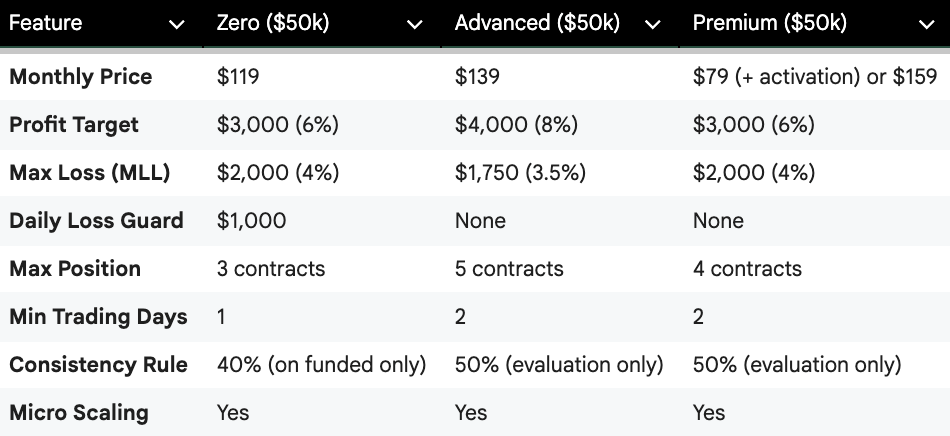
All three pay a flat 90% split from day one and weekly payouts. The differences are in price, contract size, targets, the daily loss rule, and where the consistency rule bites. Here’s the cleanest comparison, the $50k account, which all three offer:
And the full size ranges:
Zero: $25k ($79/mo), $50k ($119/mo), $100k ($239/mo). The cheapest way in, smallest contract sizes (1/3/6), and the only plan with a daily loss guard. No consistency rule on the evaluation, but a 40% consistency rule on the funded account.
Advanced: $50k ($139/mo), $100k ($279/mo), $150k ($419/mo). The biggest contract sizes (5/10/15), the highest targets (8%), the tightest MLL as a percentage (3.5%), no daily loss guard, and no consistency rule once you’re funded. Priciest monthly.
Premium: $50k, $100k, $150k, sold on an activation-fee model: a lower monthly ($79 / $159 / $239) with a one-time $149 activation fee when you get funded, or a higher monthly ($159 / $269 / $379) with no activation fee. Middle-of-the-road contract sizes (4/8/12), 6% targets, no funded consistency rule.
Quick read: Zero is for smaller accounts and cost-conscious starts (just mind the daily cap and the 40% funded rule). Advanced is for experienced traders who want maximum size, the biggest payouts and the fewest restrictions once funded, and will pay for it. Premium is the flexible middle, and the activation-fee toggle lets you trade a lower monthly against a fee later.
How the consistency rule works
Don’t ignore this one, it’s where fast passes go to die.
Premium & Advanced evaluations: 50%. No single day’s profit can be 50% or more of your net evaluation profit. Practically, keep your best day at or under half your target ($1,500 on a $3,000 target, $2,000 on a $4,000 target, and so on).
Zero funded accounts: 40%. On the qualified account, no single day can be ≥40% of net profit since your last payout. Break it and you’re not breached, you just can’t withdraw until you trade enough to bring the ratio back in line. It resets after each payout.
Advanced & Premium funded accounts: no consistency rule (Premium just asks for at least $1 of net profit in the cycle).
The whole point is to reward a smooth equity curve over a single lucky session. Alpha even publishes a consistency calculator so you’re not doing the maths by hand.
How payouts actually work
This is where a lot of firms get cute. Alpha’s policy is refreshingly plain, and it’s the same backbone across all three plans:
Pay yourself up to 4 times a month, once you’ve banked 5 winning days of $200+ (they don’t need to be consecutive).
Each request, you can withdraw up to 50% of the profit sitting in the account; the rest stays as drawdown cushion.
You receive 90% of whatever you request.
Everything is processed in 48 business hours or less.
The per-plan limits:
Advanced: minimum $1,000, maximum an industry-leading $15,000 per request on every size.
Premium: minimum $500, with the cap stepping up each time: $3,000 → $3,500 → $4,000 → $5,000 → $6,000 from the fifth request on. No consistency rule, but you need to be net positive in the cycle.
Zero: minimum $200; caps of $1,000 (25k) / $1,500 (50k) / $2,500 (100k), and the 40% consistency rule has to be satisfied before the payout button unlocks.
There’s also a path beyond the sim, Alpha Prime. Once a qualified account reaches +$40,000 in payable balance or 5 payout cycles, Alpha reviews your trading history; from there you can take the Alpha Prime Program (a 60% split plus a 12-month monthly salary, weekly strategy calls and London trading-floor access) or a Generic Live Program (80% split, no extras). That’s its own write-up.
The catch (because there always is one)
I’d be useless to you if I only sold the upside. Things to go in with your eyes open about:
It’s a subscription, not a one-time fee. You pay every month until you pass. Drag out an Advanced evaluation and $139 - $419/month adds up fast. The firms that charge once can be cheaper if you’re slow.
Qualified accounts are simulated. “Funded” here means a simulated account you withdraw real profit from, real live capital comes later via Alpha Prime. That’s standard for the industry, but set your expectations accordingly.
Zero is the cheapest but the most rule-heavy. On top of the daily loss guard and the 40% funded consistency rule, Zero qualified accounts also can’t enter within 2 minutes either side of high-impact (red-folder) news. Advanced, Premium and all evaluations have no news restriction at all.
A breach is a breach. The MLL is checked on floating equity, so an intraday spike into your limit liquidates you even if you’d have closed green.
Rules and prices change. Everything here is current as of writing and pulled from Alpha’s own help centre, but check your dashboard the day you act.
Who Alpha Futures is for
It suits day traders who take intraday heat but close near their highs, the EOD drawdown is built for exactly that style and is genuinely kinder than intraday-trailing competitors. Beyond that: Zero for smaller or budget-conscious starts, Advanced for experienced traders who want max size, the $15k payout cap and minimal funded restrictions, and Premium if you want flexibility and like the activation-fee option.
It’s a worse fit if you want to swing a single huge position for one lottery day (the consistency rule kills it), or if you’d rather pay once than subscribe monthly.
My take
I think Alpha Futures is a good, highly reputable firm. What sets them apart from the crowd isn’t flashy marketing, but their structured, trader-friendly approach to risk management.
Beyond that, their 90% profit split, fast 48-hour payout processing, and unique path to a salary-backed live program through Alpha Prime show they are built to reward longevity rather than exploit quick failures. If you can navigate the monthly subscription model and value a firm with transparent, stable infrastructure, Alpha is an excellent partner to scale your trading.
If you want to give them a try, you can start your evaluation below:
And if breakdowns like this are useful, subscribe - I publish honest prop-firm and NQ strategy breakdowns every week.
Educational content only. Not financial advice. Trading futures carries substantial risk of loss. Prop-firm “funded” accounts referenced here are simulated unless stated otherwise. Rules, pricing and parameters are current as of publication and sourced from Alpha Futures’ own help centre; verify the latest on their dashboard before purchasing. Affiliate links may earn me a commission at no cost to you.
Affiliate disclosure: I partner with Alpha Futures, so some links above are affiliate links. It costs you nothing extra, and it doesn’t change the numbers - everything here is pulled straight from Alpha’s own dashboard and help centre. This is education, not financial advice.
Next up: Alpha Futures vs Lucid Trading vs Tradeify