
Best Futures Prop Firms for Beginners in 2026 (An Honest Take)
If you are a beginner, the best futures prop firm is not the one with the biggest account. It is the one with a forgiving drawdown, a low real cost to get funded, and a simple one-step evaluation.

What actually matters for a beginner (and what to ignore)
Forget the marketing. Three things decide whether a firm is beginner-friendly.
1. Drawdown structure. This is the single most important filter and almost nobody leads with it. End-of-day (EOD) trailing and static drawdowns are forgiving: they measure your account at the close, so a bad intraday swing does not instantly kill you. Intraday trailing drawdowns do the opposite. They track your live equity tick by tick and can “spike you out” of an account you were never actually losing. Beginners get wiped by intraday drawdowns more than by anything else. All three firms below use EOD trailing.
2. The real cost to get funded. Not the sticker. More on this below, because it is where most beginners lose money before they ever place a trade.
3. A simple one-step evaluation. Hit a profit target, respect the drawdown, get funded. No two-step ladders, no extra checkpoints. All three picks are one-step.
What to ignore: account size. A $150K account does not make you a better trader. It makes the sticker price bigger and the daily loss limit sound generous while the math that actually fails you stays exactly the same. Start at 25K or 50K. Prove you can follow rules for a month. Scale later, if ever.
The cost-to-funded math nobody shows you
Here is the part that matters most and gets buried everywhere else.
The sticker price is a lie of omission. Your real cost is the sticker times the number of attempts it takes you to pass. And most beginners do not pass on the first try. Pass rates on one-step evaluations sit somewhere around 15 to 17 percent industry-wide. Topstep, for example, has reported that roughly 16.8% of its Combines pass. So budget for 2 to 4 attempts, not one.
That changes which cost model is actually cheaper for you:
Subscription firms (Alpha Futures) are cheap if you pass in month one. Every extra month is another full fee. Grind for four months and a “$79 account” quietly became a $300+ account.
One-time-fee firms (Tradeify, Lucid) charge you once per attempt. A retry is a reset fee or a rebuy, and your downside per attempt is fixed and predictable.
Honest takeaway: if you are a beginner who will probably not pass first try, a one-time fee with a cheap reset is usually the safer cost structure. The subscription model only wins if you are fast and disciplined, which by definition most beginners are not yet.
The shortlist
Alpha Futures - the most forgiving drawdown
The reason it leads. Alpha uses an EOD trailing Maximum Loss Limit, which is structurally kinder than the intraday version most firms run. One-step evaluation, profit splits from 70% up to 90%, and a longer, stronger track record than almost anything else on this list (it is part of Alpha Capital Group and carries one of the highest Trustpilot ratings in the space). The Zero plan has no activation fee.
The catch: it is a monthly subscription. Pass fast or it gets expensive. The Standard and Advanced plans also carry a one-time $149 activation fee once you qualify.
Best for: the beginner who is confident they can pass in a month or two and wants the most forgiving drawdown to do it on.
Tradeify - the one with no subscription clock
The fixed-cost pick. One-time fee, no monthly bill, no activation fee, so the meter never runs while you learn. EOD trailing drawdown that locks at your starting balance plus $100 once you are far enough ahead, and the Growth account behaves closest to a static floor. That is the single gentlest structure for a beginner. 90/10 split.
The catch: The lineup is confusing. Growth, Select, and Lightning each handle consistency and daily-loss rules differently, and some rules change again once you go from evaluation to funded. Easy for a first-timer to misread which rule applies to them.
Best for: the beginner who wants one fixed, predictable cost and the most forgiving structure to learn risk management on.
Lucid Trading - the cheapest clean entry
The fast, simple one. One-step evaluation, no activation fee, one-time pricing, EOD trailing drawdown, and a 90/10 split (with the first $10K paid at 100% on some account types). Payouts are genuinely fast, often processed in minutes, and the Flex account runs with no daily loss limit.
The catch: it is the newest of the three (founded 2025), so it has the shortest track record and the most unknowns.
Best for: the beginner who wants the cheapest clean one-step with fast payouts and is comfortable backing a younger firm.
Side by side
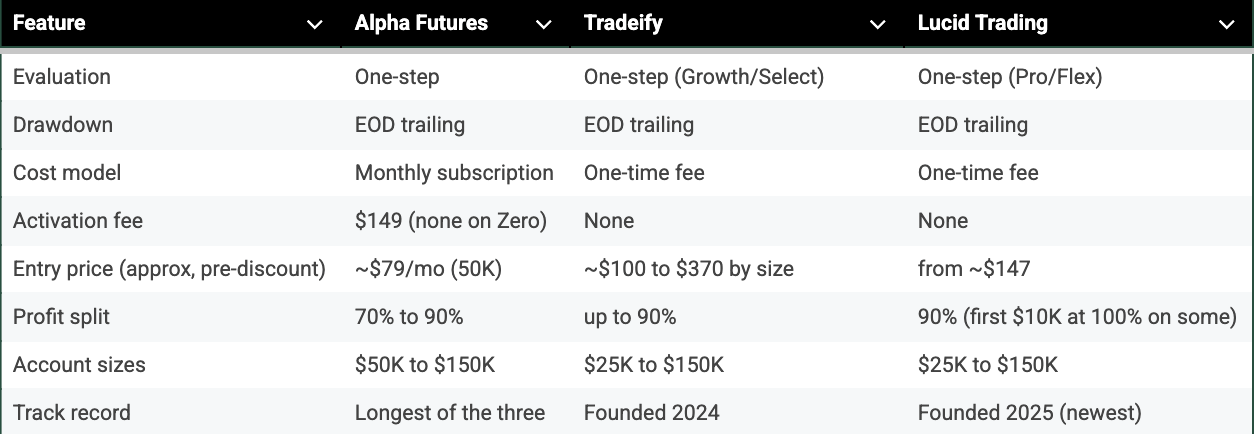
Prices and rules shift constantly in this industry. Always confirm the current numbers on the firm’s own page before you pay.
Quick decision
Want the most forgiving drawdown and can pass quickly? Alpha Futures.
Want a fixed cost with no subscription pressure and the gentlest structure to learn on? Tradeify.
Want the cheapest clean entry with fast payouts, and fine backing a newer firm? Lucid Trading.
The bottom line
None of these firms make you profitable. The firm is the easy part. Your risk management is the hard part. Pick one, start small, and prove you can follow the rules for a full month before you even think about scaling.
And if a firm’s marketing is selling you a $150K account and a lifestyle, close the tab. The boring firm with the forgiving drawdown is the one that gives you a real shot.
Disclosure
All three firms above are ones I have affiliate deals with. If you use my codes or links, I earn a commission. Discount my opinion accordingly.
I am telling you this because most “best prop firm” lists do not. The links are real and they save you money. But you should know the money flows both ways before you make a decision.